
Scotch Whisky CollectionMartin Miles’s private archive home

Scotch Whisky Collection

A private Scotch whisky archive—not an offer for sale.

Method · Memory · Measure

Tasting

A dedicated place for the collector’s laws of tasting, the discipline behind each note, and the scoring system that turns an impression into a useful record.

01Method
Five deliberate passes
02Scale
100-point framework
03Principle
Notes before numbers
Enter the method
A mature assessor holds a tulip whisky glass to the light before making notes.
Condition before conclusion

01 · Observe

Read the room, then the glass.

SWA correspondence · Hearing + Sight

The first pass records what is physically present before the mind starts naming aromas or judging quality.

Begin with a clean, tulip-shaped glass in a quiet room without perfume, cooking smells or smoke. Log the sample, date, glass, room, serving temperature, whether the identity is known or blind, the measured pour and the time allowed to rest. The SWA’s traditional route begins with the sound of the opening and pour, then moves to sight; this archive holds both inside Observe.

Raise the glass against neutral light. Record hue, depth and clarity, then give it one controlled swirl and watch how the spirit returns down the bowl. The movement and ‘legs’ are observations, not a quality grade. Colour can offer a clue to maturation, but it does not prove age, cask type or value and must never influence the final score by itself.

Write literal evidence first—pale gold, clear, slow-moving—before interpretation such as refill bourbon or long maturation. If the identity is hidden, keep it hidden until every sensory note and the provisional score are complete.

Context
Sample, date, room, glass and rest time
Appearance
Hue, depth and clarity
Movement
How the liquid coats and returns
Discipline
Observation before interpretation
A mature assessor gently noses a tulip glass beside water and an open notebook.
Short breaths, patient returns

02 · Nose

Approach the aroma in layers.

SWA correspondence · Smell

Aroma is gathered gradually. The goal is not the longest list of descriptors, but a clear record of intensity, development and change.

Let the glass settle, then bring it towards the nose rather than plunging the nose into the rim. Take two or three short, gentle breaths and move away. High-strength spirit can numb perception; distance and patience reveal more than one deep inhale.

Record the first impression, then move from broad families to particulars: perhaps grain, fruit, floral notes, spice, oak, smoke, mineral or savoury character. Use familiar language and write only what you can defend. The SWA notes that different people detect different aromas and that description becomes easier with practice; disagreement is information, not failure.

Return after a minute. Once the neat nose is fixed, add only a few drops of still, unchilled water when useful, allow the glass to settle again and record what opens, closes or changes. Never replace the neat note with the diluted one—keep both conditions visible.

First nose
Immediate family, intensity and alcohol
Development
What appears after rest
With water
Opened, softened, muted or unchanged
Confidence
Certain, probable or tentative
A mature assessor takes a small measured sip from a tulip whisky glass.
Arrival, development, structure

03 · Palate

Take one small, deliberate sip.

SWA correspondence · Taste

The palate pass separates first impact from what the whisky becomes across the mouth and over time.

Take a small sip and let the whisky coat the mouth. The SWA traditional guide asks the taster to move the spirit across the palate and notice flavours that may differ from the nose. Do not rush to swallow and do not force the experience into a fixed tongue map; attend to the whole mouth.

Write in sequence. Arrival is the first contact: sweetness, acidity, alcohol, smoke or spice. Development is what unfolds next: fruit, cereal, oak, savoury notes and transitions. Structure describes intensity, weight, texture and the way those elements hold together. Separate alcoholic heat from flavour concentration.

Taste neat before making any adjustment. If water was useful on the nose, add a controlled amount and repeat one small sip. Note whether dilution improves definition and balance or simply thins the whisky. The better condition is part of the record, not a rule that every Scotch needs water.

Arrival
The first three seconds
Development
Sequence and changing flavours
Structure
Weight, texture and intensity
With water
Gain, loss and preferred condition
A mature assessor pauses after a sip with the whisky glass set down and a pencil poised over notes.
What remains when the sip is gone

04 · Finish

Set the glass down and wait.

SWA correspondence · Touch

Finish is judged in the quiet after the sip: duration, direction, mouthfeel and the quality of what remains.

Do not write the finish while still tasting the arrival. Put the glass down, breathe normally and notice how long clear flavour persists. Use short, medium or long as a first measure, then describe whether it fades evenly, changes direction or ends abruptly.

This pass maps directly to the SWA’s final sense, Touch: how the whisky feels in the mouth and whether flavour lasts or disappears quickly. Record texture—perhaps light, creamy, oily, waxy, drying or tannic—without treating richness as automatically superior.

Name the final flavours and the shape of the aftertaste. Distinguish warming alcohol from persistent flavour, and complexity from simple duration. Refresh with water and pause before another sample so the next whisky does not inherit the previous finish.

Length
Short, medium or long
Direction
Fades, develops or turns
Mouthfeel
Weight and tactile character
Aftertaste
The final clear flavours
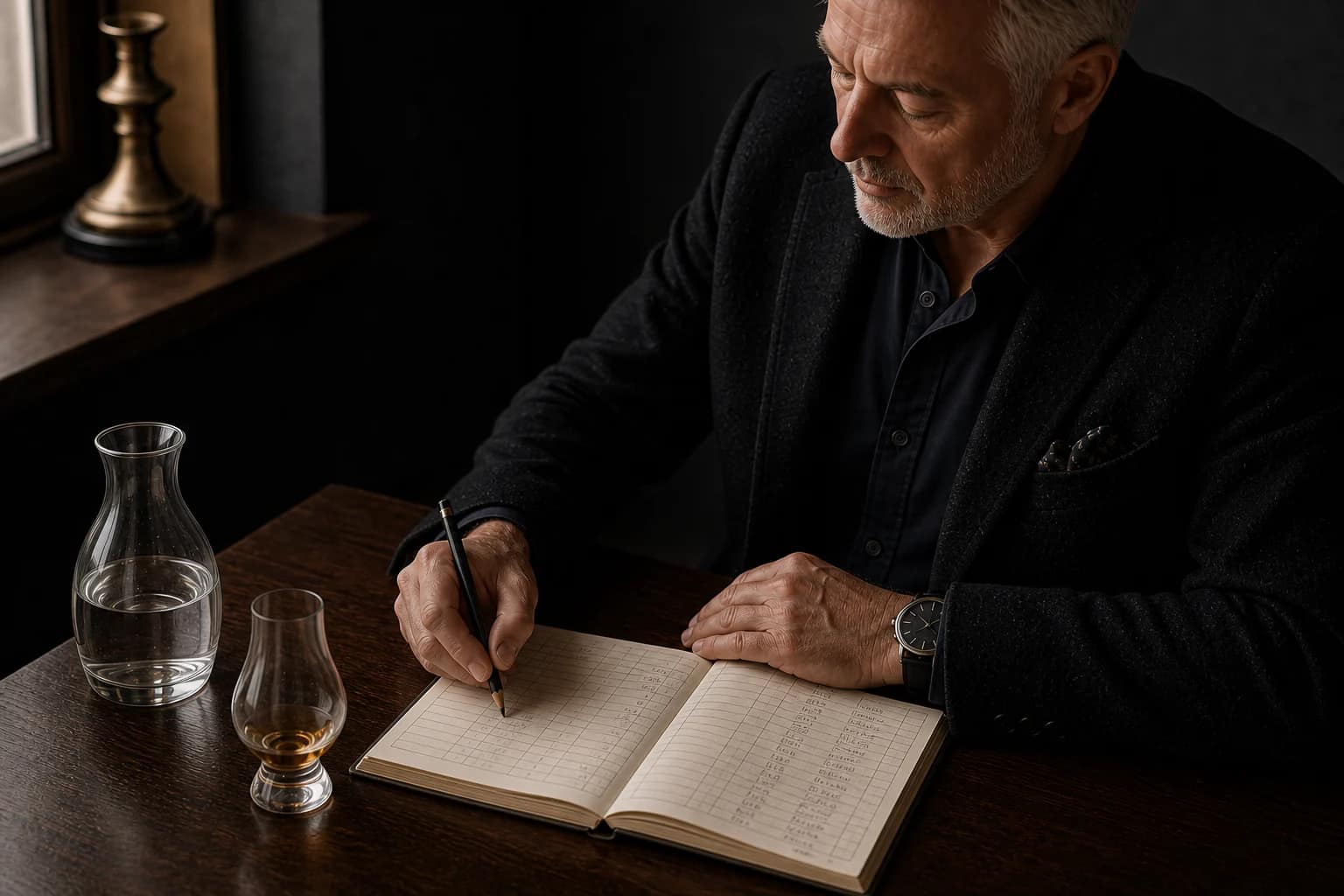
A mature assessor records the completed whisky assessment in a structured ledger.
A traceable record, not a verdict

05 · Score

Let the number come last.

Archive layer · Not an SWA requirement

Scoring compresses the written encounter into a comparable archive value. It never replaces the note that produced it.

Complete every descriptive field before showing or calculating a number. This fifth pass is Martin Miles’s collection method, not part of the SWA five-sense guide. Its purpose is consistency inside this archive, not a universal declaration of quality.

The working scale is additive: Nose, Palate, Finish, Balance and Character each receive up to 20 points. Add them for a transparent total out of 100. Price, age, rarity, packaging, reputation and collectability receive no points. A distinctive whisky is rewarded only when that identity is coherent in the glass.

Publish the total with its five components, author, date, scale, blind or open status, serving condition, water used and confidence. Retasting may create a new dated record; it must not silently overwrite the first. Compare scores only when the method and conditions are comparable.

100-point construction

  • NoseClarity, development, expressiveness and definition./ 20
  • PalateFlavour, structure, texture and development./ 20
  • FinishPersistence, evolution, cleanliness and aftertaste./ 20
  • BalanceIntegration of spirit, oak, alcohol and flavour./ 20
  • CharacterA coherent, memorable identity—not price or rarity./ 20
Total— / 100
Provenance
Author, date and 100-point scale
Conditions
Blind or open, neat or diluted
Evidence
Five component scores plus the note
Confidence
High, medium or low

Collective practice

Practice belongs to everyone.

In Scotland, tasting skill is not confined to master blenders, professional judges or polished brand rooms. It is also exercised around ordinary tables, where enthusiasts compare aromas, return to a glass after a few minutes and add water with care.

Perception becomes more precise through repetition and conversation: naming what is present, admitting what is not, and testing a first impression against other palates. The room may be modest, but the discipline is real. Sessions like this keep Scotland’s tasting culture social, curious and continually improving.